Unlocking the Piano
Beauty is matter in resonant relation

This is the text of a “sermon” I gave for the Ethical Society of St. Louis on 26/07/2026. The Ethical Society is a Humanist congregation - the one I used to lead. I don’t usually publish my sermons, but this one is very close to a chapter in my upcoming book, so I thought - why not! If CS Lewis can publish his sermons, so can I. Enjoy!
A Multicoloured Concrete Drum
Most of my job is unlocking the piano.
As Lead Chaplain for the University of Sussex, I work from an office below the chapel. Our chapel is housed in an extraordinary 1960s building, a stone cylinder with a shallow copper cone for a roof. The chapel is upstairs, a circular space with walls of concrete and coloured glass. Massive concrete blocks alternate with rich, thick, colourful panes, to create a kaleidoscopic tapestry, a warm cocoon of light.
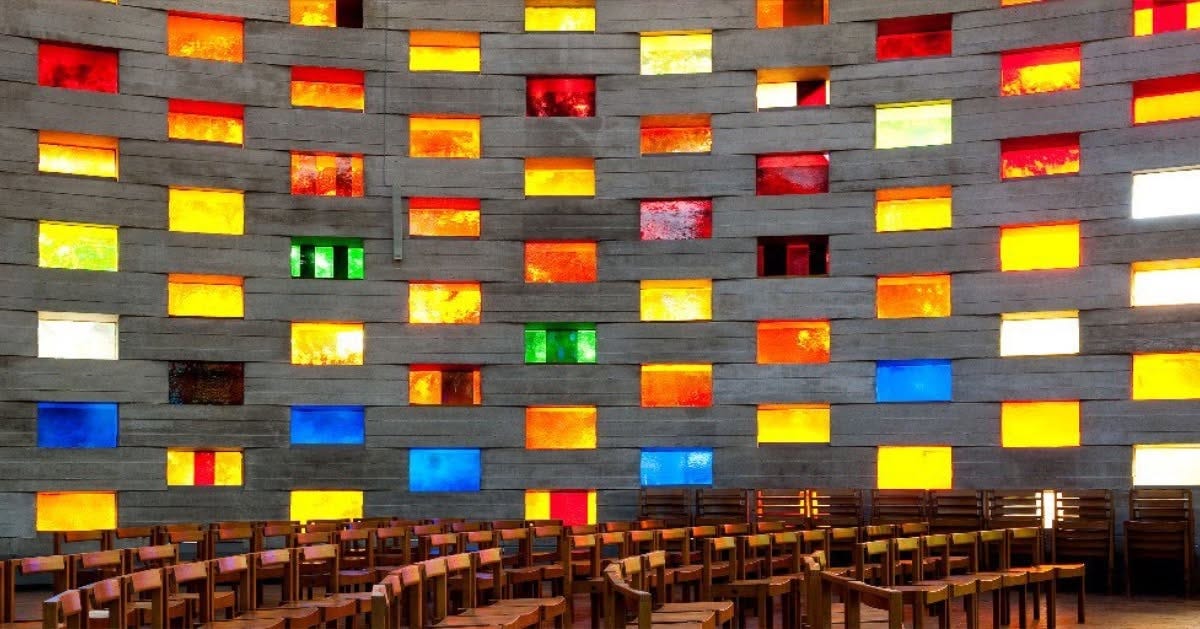
It is not unlike your foyer, in fact – my chapel and your building were built within two years of each other, speaking similar architectural languages.
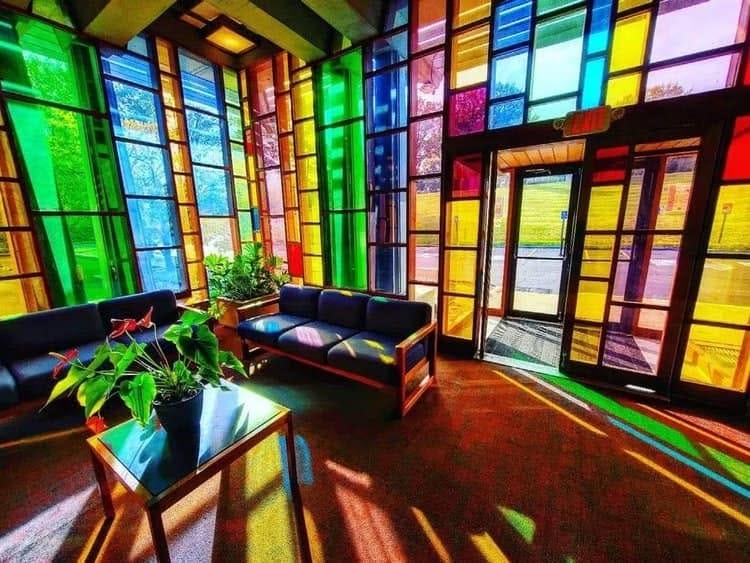
So, imagine the rainbow glass of your foyer covering the walls of a circular stone room the size of the auditorium you’re in right now. You would be surrounded by colour, inside a resonant concrete drum. That is my chapel, and my office is below it.
The chapel has two pianos in it. One is old and tired and creaky. The other is also old — but it is a Steinway, so we keep it locked. Students come every day to play the piano, and they always want to play the Steinway.
So I unlock it for them.
Some students play pop music. Others play Bach. Some like musical theatre. But one student plays…waterfalls. Waterfalls, and thunder, the rush of wind before it dies. Almost every day this student comes to play. He brings no sheet music with him. Instead, he improvises extraordinary, trance-like explorations of sonic territory. Rich, rumbling, textured things.
What’s amazing is the thickness of the sound. As he plays, the sound densens and deepens. It feels like I could run my hands through it. Sometimes there are strains of melody, flickers of tune that rise up from pattern to awareness, arpeggios up and down. But mostly it is quickly repeated chords layered and layered and layered, the pedal down to sustain them, some given more attack before they fall again into the mixture.
I sit in the choir stalls listening to him play. The music seems like it goes on forever, it never stops, a continuous field of sound, sometimes gathering and gaining force, shaking the whole multicoloured room, resounding round the concrete drum, then subsiding like a wave after it has crashed. Sometimes insistent, sometimes pleading, sometimes urgent, sometimes angsty, then relaxed, resigned, momentarily satisfied.
My student’s head is bowed right down to the keyboard, his glasses slightly catching the light, gleaming against the piano’s dark wood. Suddenly he hammers furiously. I can hear the hammers pounding, the strings rebounding off them, and now a melody gathers as he keeps exploring. My skull buzzes with sound.
It is so very beautiful.
Searching for Beauty
I wonder what my student’s searching for, in all that music. Why does he come back, day after day to play? Beneath the chords, between the notes, inside that cavernous sound, what is he hoping to find?
Perhaps the secret’s in that word: “beauty”. That’s the word I reach for when I try to describe his music. Some students’ piano playing is technically impressive. Much of it is fun and lively. Some is, honestly, enthusiastic, but not so good.
His is beautiful. It fills you up. Just thinking of it, my breathing changes, my fingers tingle. There’s something special here.
Philosophers and theologians have long had the intuition that there is something special about beauty – and many claim that beauty is one of the signals of the divine. Beauty, they argue, is not merely a pleasing arrangement of this-worldly stuff, but a portal to another, infinite world. One of the purest expressions of this idea comes from CS Lewis, the novelist who wrote the Narnia books: The Lion, the Witch, and the Wardrobe etc. Have you read those books, or seen those films? Lewis was also a devout Christian and one of the most influential Christian theologians of the 20th Century. He wrote a lot about beauty – what it is and what it means. In one of his books, The Weight of Glory, he wrote:
“We do not want merely to see beauty… We want something else which can hardly be put into words—to be united with the beauty we see, to pass into it, to receive it into ourselves, to bathe in it, to become part of it.”1
Lewis goes further. He argues that we don’t just want the perceptual experience of beauty itself. We are not satisfied by the music on its own. Rather, our appetite for music – and other expressions of beauty – points to something else. In a famous passage, he writes:
“These [beautiful] things…are only the scent of a flower we have not found, the echo of a tune we have not heard, news from a country we have never yet visited.”2
Lewis argues that beauty, and the strange longing that arises in us in response to it, is evidence that there is something out there that could satisfy that longing. The music doesn’t satisfy it, so what does? What is beauty pointing us towards?
Perhaps predictably, given Lewis’ Christian beliefs, he thought beauty was calling us to heaven, and to God. Beauty is the awakening in we finite creatures of a desire for an infinite homeland. Our hunger for beauty is never sated because what we want, we cannot get in this life – only in the next. But the fact we hunger for beauty at all is evidence that there is a next life. Because, Lewis argues, just as we would not develop a hunger for food were food not something real, and just though we would not develop a yearning for romantic companionship were we not the sort of species we are, our insatiable desire for beauty, too, is rooted in something real: the existence of a world beyond this one.
“At present”, Lewis writes, “we are on the outside of the world, the wrong side of the door…[But] Some day, God willing, we shall get in.”3
This-worldly beauty, in Lewis’ telling, is something like a sign, a hint, a whisper of another place: in one of his novels a character calls it “The place where all the beauty came from”. We are arrested by beauty because it calls us from elsewhere to elsewhere.
I am an atheist and a Humanist. In fact, I am a professional Humanist, one of very few! I do not believe in God or in heaven. But when I think about my student in the chapel, it’s not so easy to dismiss Lewis’ interpretation.
It is too simple, for instance, to say “My student plays the piano because enjoys it.” Of course he does. But he doesn’t just enjoy it: he needs it. He comes back day after day, he cannot get enough. I see in his behaviour and attitude the “longing” Lewis talks about.
Other aspects of Lewis’ description ring true, too. As I watch my student, he leans into the keyboard, head bowed, eyes closed, aching to get close to it.
It looks like love.
Sometimes, as he sways and bobs and surges and flows, he seems to merge with the music entirely.
It looks like devotion.
There is something more than simple pleasure here. Lewis says we want “to be united with the beauty we see, to pass into it, to receive it into ourselves, to bathe in it, to become part of it.” That is right. My student seems to wish to be united with the piano, to pass into the music, to receive it into himself, to bathe in it. That is, indeed, how it feels to sit inside that concrete multicolour chapel-drum surrounded by the music that he makes: it is a sonic bath, and I always want more.
And, yes, it seems to pull me out of myself. People call this “transcendence”, the expansion of experience so much we seem to break the bounds of ego and float free.
Yes, I said “transcendence”. I know many Humanists dislike the term – I’m just telling you how it feels to sit in that chapel with my student and his music. The word feels about right somehow, when I’m sitting there in my sonic bath.
But is it right? Is Lewis right that beauty calls from a transcendent mountaintop, the place where all beauty came from?
Inscendence Instead
Don’t worry, I’m not converting to Christianity in real time. Instead, I offer a different explanation: I think beauty comes from this mundane world, from matter arranged in resonant relationship. Beauty may call us out of ourselves, yes, but it doesn’t call us beyond this world. Rather, it discloses possibilities within this world that are normally dormant. Beauty doesn’t pull back a veil to reveal a world beyond reality; rather, beauty is like a singing glass. Under most conditions, a wineglass will not sing. But if you strike it right, and carefully, it will make a gorgeous noise – and remind us that this world harbours possibilities we usually ignore.
Let us return to the beginning.
Most of my job is unlocking the piano.
The chapel has two pianos in it. One is old and tired and creaky. The other is also old — but it is a Steinway. Students come every day to play the piano, and they always want to play the Steinway.
Why do they want to play the Steinway?
All pianos are machines. We call them “instruments”, and that word is instructive. There are many kinds of instruments: medical instruments, scientific instruments, musical instruments. An “instrument” is a tool that serves a purpose – it is a thing for doing. Medical instruments help us do medicine better. Scientific instruments help us do science better. Musical instruments help us do music better. Do beauty better.
Students want to play the Steinway because that material machine is a better instrument, a better tool. When they play that one, the spell the music casts is more powerful. Not because the Steinway has a special essence, not because it is infused with something of the divine, but because of the tautness of its strings, the precision of its hammers, the shape of its soundboard. Its arrangement of physical parts makes more resonant sounds, creating richer music.
When I attend, too, to the experience of listening, its materiality emerges. I can feel the music press against me, feel it vibrating the bench beneath me, feel it rattling my chest and my shaking my teeth. The music is a meaty, matterly thing.
Even the term “transcendence”, when I attend more closely, feels subtly wrong. That word has many meanings, but it often means going beyond the physical, entering a spiritual or divine reality. Certainly, it seems this is what CS Lewis is describing when he talks about getting to the right side of that door, getting in to reality. Transcendence is us being called beyond the threshold.
But that’s not quite how it feels when I’m absorbed in my student’s music – not really. I feel an expansion of myself, yes. A connection with the world, yes. Like I’m going somewhere, yes – that too. But not like I am going somewhere else. I don’t feel summoned beyond that multicoloured chapel. Instead, I feel more habituated within it.
My father’s family is Welsh, and there is an old Welsh word – “cynefin” (pronounced kuh-nev-in). It means habitat, familiarity, a sense of belonging. But not abstract belonging: cynefin is the place where you have roots, like a path well-trodden through a field, a place marked by the tracks you’ve made through it, and the impressions you’ve left.
That’s how it feels to listen to my student’s music: the music does not make the room disappear, it makes the room more present. I notice the vibrations in the bench beneath me. How the concrete walls resound the soundwaves back. I see the coloured glass, how light thickens as it passes through the windows. Even my own body responds: my chest, my teeth, my skull all singing. I feel like a string dancing in sympathetic vibration with the music that he plays. We are connected, not transported.
That is why “transcendence” feels wrong. I am not moving “out” or “above” this world – transcendence; I am connecting more deeply to it – inscendence.4 For a few minutes, as my student plays, he, and the piano, and the room, and I are part of the same song. As the world around me starts to hum – and I along with it – I feel more at home.
Perhaps we need a different philosopher. Iris Murdoch called beauty “an occasion for unselfing.” Her idea was, that when we encounter beauty, something in the world captures our attention, expands our horizons of perception, and leaves us with a broadened outlook. She wrote:
“I am looking out of my window in an anxious and resentful state of mind, oblivious of my surroundings, brooding perhaps on some damage done to my prestige. Then suddenly I observe a hovering kestrel. In a moment everything is altered. The brooding self with its hurt vanity has disappeared. There is nothing now but kestrel. And when I return to thinking of the other matter it seems less important.”5
That captures it, I think. That captures the extraordinary absorption beauty can sometimes provoke: “There is nothing now but kestrel.” Sometimes it feels as if there’s nothing but my student’s music. There, too, is expanded awareness: beauty can change our sense of what matters. I often leave the chapel feeling lighter. But notice: in this description of Murdoch’s, there is no “elsewhere”, no “other country”, no “real reality” behind a closed door. The kestrel is as much part of this world as Murdoch is. And so too with me, my student, the Steinway, and the chapel: the movement provoked by beauty is not upward beyond this world, but outward within it.
So now we have a new idea of beauty. We are not “on the outside of the world” – we’re in the only world there is. But sometimes, when we arrange this world just right, it sings to us. My student’s experience playing the piano, my experience listening to his music: neither summon us beyond this world. Instead, they disclose what this world is capable of – and what we are capable of – when we align things well. Beauty is not an escape, but a revelation.
Some people tell me beauty is a bolt from beyond: transcendent light piercing the veil between our world and the next. When we lose ourselves in beauty, they say, we briefly escape this world, flying up and out.
I say beauty is matter in resonant relation. Relation to itself, and to us. When we find ourselves in beauty, we deeply inhabit this, our homeworld, connecting among and through.
Lewis calls you to heaven. I am calling you home.
Not transcendence.
Inscendence.
The Weight of Glory, and Other Addresses, CS Lewis, p. 12-13
ibid, p. 5
ibid, p. 13
Thomas Berry seems to have coined this word: he describes it as “not moving beyond the life we know but climbing into it, looking for its kernel.” I use it in a slightly broader sense, relevant to more areas of life. But the idea is very close.
The Sovereignty of Good, Iris Murdoch, p. 82 - And yes, I know Murdoch takes this thought in a Platonic direction. I will argue in my book that this movement is unnecessary, but here I am just talking about her example. Nothing Platonic in her chosen example!